Story Details
Story content as edited from the admin panel.
In southern Jordan, near the quiet plains of Mutah today, one of the greatest stories in history unfolded — not merely as a battle, but as an epic tale of resilience, faith, and sacrifice.
There, more than fourteen centuries ago, a small group of swords rose against a massive empire, writing one of the most powerful chapters in Islamic memory.
The story began when Prophet Muhammad ﷺ sent a messenger carrying a message of peace and invitation to the ruler of Busra in Greater Syria. His name was Al-Harith ibn Umair Al-Azdi. He traveled calmly through the desert, carrying neither sword nor army, only a letter. But along the way, he was intercepted by Shurahbil Al-Ghassani, one of the Roman allied commanders, and was killed in an incident that deeply shocked the Muslims, as killing messengers was considered a betrayal of all customs and traditions, even in those times.
In response, it was decided that an army would march north from Madinah. It was not a massive force, but only three thousand fighters, led in succession by three of the greatest companions of the Prophet:
Zayd ibn Harithah, then Ja'far ibn Abi Talib, and then Abdullah ibn Rawahah.
The army crossed long deserts, mountains, and valleys until it approached the land of Mutah. There, troubling news arrived…
The Roman forces and their allies were not a few thousand, but tens of thousands. Some historical narrations even spoke of two hundred thousand soldiers filling the plains with armor, spears, and cavalry.
Silence spread among the soldiers.
Only three thousand men facing a force that looked like an endless sea.
That night, the men sat around their fires thinking deeply. Some suggested returning to Madinah and requesting reinforcements, while others wondered how they could possibly face such overwhelming numbers. Then Abdullah ibn Rawahah stood among them, his voice cutting through the fear and hesitation:
“O people, what you dislike is exactly what you came seeking… martyrdom.”
A few words… yet they ignited courage in every heart.
At dawn, the Battle of Mutah began.
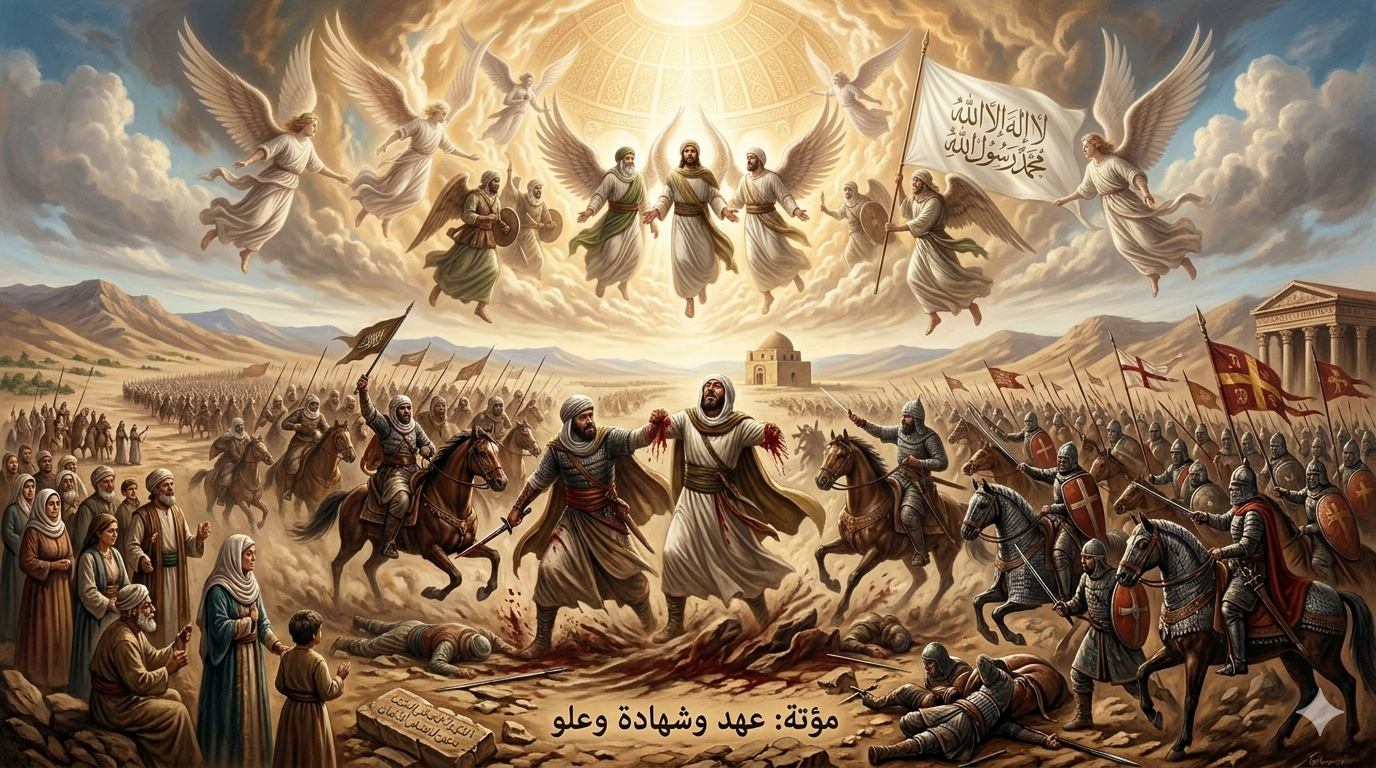
The earth trembled beneath the sound of horses and clashing swords. Zayd ibn Harithah raised the white banner and charged toward the front lines. The battle was fierce beyond anything the desert had witnessed before. Thick clouds of dust filled the air, battle cries echoed across the hills, and swords struck without pause.
Zayd fought bravely until he fell as a martyr while still carrying the banner.
In a critical moment, Ja'far ibn Abi Talib rushed forward and seized the flag immediately. He fought like a lion in the heart of battle, surrounded by swords from every direction, yet never retreating. His right hand was severed, so he carried the banner with his left. Then his left hand was cut off as well, and he held the banner tightly against his chest with his arms so it would not fall.
Ja'far finally fell, his body covered with wounds.
It is said that Prophet Muhammad ﷺ later declared that Allah had replaced his arms with wings in Paradise, and from that day he became known as “Ja'far Al-Tayyar” — Ja'far the Flyer.
After him, Abdullah ibn Rawahah carried the banner.
He advanced while reciting verses to strengthen his own spirit, knowing that death stood very near. He looked at the enormous enemy ranks before him, yet continued fighting until he too was martyred.
Three commanders… falling one after another.
At that moment, the battle reached its most dangerous stage.
The small Muslim army was close to collapsing, while the Roman forces pressed from every direction. Then a man known for his military brilliance and courage stepped forward:
Khalid ibn Al-Walid.
He quickly seized the banner and reorganized the ranks amid the chaos. It was no longer simply a battle — it was a struggle for survival.
Khalid fought fiercely, and it was said that several swords broke in his hands because of the intensity of the fighting. Yet he realized that continuing the battle in the same way would mean the complete destruction of the army. So he devised a brilliant strategy: during the night, he repositioned the troops and switched the flanks, making the army appear as though fresh reinforcements had arrived from Madinah.
When the Romans saw the new movements, they hesitated, fearing that additional Muslim forces had entered the battlefield. Khalid seized the opportunity and successfully withdrew the Muslim army in an organized retreat across the desert, preserving the lives of the remaining fighters.
Mutah was not a conventional military victory, yet it became a timeless symbol of resilience and steadfastness against impossible odds.
Three thousand men stood against one of the greatest empires on earth and wrote, with their blood, a story that still lives today.
And in the land of Al-Mazar Al-Janubi, the names of the three commanders remain alive in memory, where their shrines continue to receive visitors from across the Islamic world, as if the place itself still echoes with the sound of swords and banners.