Story Details
Story content as edited from the admin panel.
In the high mountains of Karak, where the scent of earth after rain mixes with the cold breeze sweeping across the valleys, Mansaf was never just a meal cooked over fire… it was a story, a symbol of honor, and a tradition through which generosity was measured.
There, inside the old stone houses of Karak, the fire would be lit before sunrise, and the women would begin preparing the famous Karaki jameed with care that resembled a sacred ritual. Jameed was never seen as an ordinary ingredient — it was the soul of Mansaf itself. Made from sheep’s milk, then dried beneath the strong sun of Karak until it became hard like white stone, it carried within it the taste of the desert, the effort of shepherds, and the scent of open pastures.
The people of Karak often said:
“Mansaf is not simply cooked… Mansaf is born.”
Because its story never begins at the dining table, but days before.
During seasons of celebration — weddings, reconciliation gatherings, or the arrival of honored guests — the entire village would know that a Mansaf feast was being prepared. Men would arrange the livestock, children would run through the streets carrying the news, and women would gather around enormous cooking pots, baking thin shrak bread by hand while the steam of boiling jameed filled every corner of the house.
As noon approached, the aroma would spread through the neighborhood…
The smell of lamb simmering in rich jameed sauce mixed with traditional ghee was enough to make anyone hungry, even if they had eaten moments earlier.
But Karaki Mansaf was never simply about food.
Sometimes it announced joy. Sometimes dignity. And sometimes sorrow. In Karak, great occasions were measured by the number of guests gathered around the Mansaf trays, and a guest’s importance could often be recognized by where he sat and which piece of meat was placed before him.
And when the Mansaf trays were finally served, the scene felt almost ceremonial.
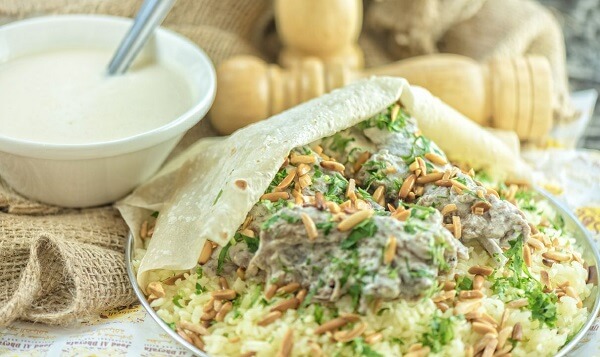
Huge platters covered with shrak bread, layered with rice soaked in jameed broth, crowned with large pieces of lamb, sometimes decorated with almonds and pine nuts, before hot jameed sauce was generously poured over everything until the entire place filled with its unmistakable aroma.
Then the men would stand shoulder to shoulder around the tray — no difference between rich and poor, elder and young man.
Because in Karak, Mansaf was not merely a dish… it was a symbol of equality, honor, and generosity.
There were also unwritten rules everyone understood:
eat only with the right hand, shape each bite skillfully, and preserve the dignity of the gathering, especially if the occasion involved tribal reconciliation, weddings, or receiving important guests.
On cold winter nights, when the wind rattled the windows of old homes, families would gather around a Mansaf tray, sharing stories and memories while the jameed quietly simmered over the fire. Children waited eagerly for the moment when the largest piece of meat would be lifted from the pot and placed proudly atop the rice like a priceless treasure.
As time passed, Mansaf spread across all of Jordan and became a national symbol recognized everywhere. Yet the people of Karak always believed their Mansaf carried a unique flavor — a flavor born from the hard mountain-made jameed, the rich local ghee, and traditions that had lived for centuries.
Even today, when someone visits Karak and sits before a true Mansaf feast, it never feels like eating an ordinary meal.